Historical Context: A Legacy of Agricultural Innovation
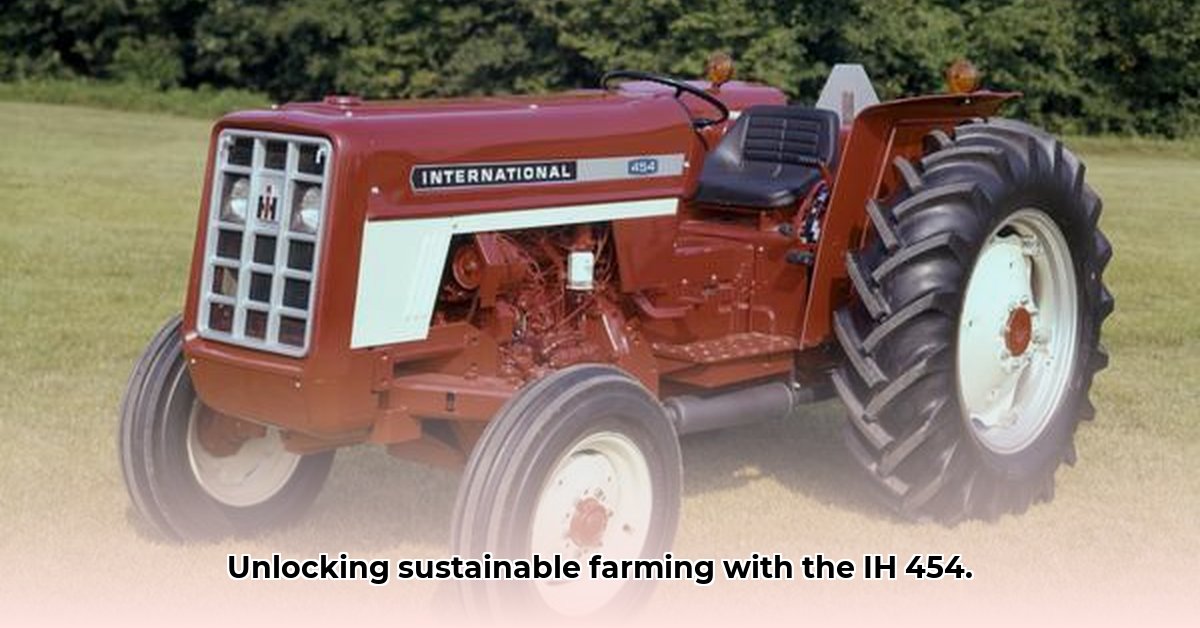
The International Harvester 454, produced from 1970 to 1973, represents a significant chapter in the evolution of agricultural machinery. This two-wheel-drive tractor, available with gasoline or diesel engines, provided a dependable workhorse for farmers during a period of significant agricultural transformation. While its power output (approximately 45-50 horsepower) pales in comparison to modern tractors, its simpler design and robust construction offer a unique perspective on sustainable agricultural practices. Understanding its history is key to evaluating its potential in contemporary contexts. For more International Harvester models, check out this helpful resource.
Specifications and Performance: A Comparative Analysis
Unlike today's high-powered tractors, the IH 454 was a relatively lightweight machine. Its lower horsepower and two-wheel-drive system limited its capabilities in challenging conditions, especially when compared to modern four-wheel-drive models with significantly higher power outputs (often exceeding 100 horsepower). Precise fuel-consumption data for the 454 is scarce, hindering direct comparisons on fuel efficiency. However, a generalized comparison highlights key differences:
| Specification | International Harvester 454 | Modern Tractor (Example) | Key Differences |
|---|---|---|---|
| Engine Type | Gasoline or Diesel | Primarily Diesel | Diesel offers better fuel efficiency and torque. |
| Power Output (HP) | ~45-50 | 100-200+ | Significant power difference impacting task capability. |
| Drive System | Two-Wheel Drive | Two or Four-Wheel Drive | Four-wheel drive offers better traction and stability. |
| Lifting Capacity | Varied, depending on configuration | Significantly higher | Impacts the size and types of implements it can lift. |
| Weight (lbs) | Approximately 4,000-5,000 | Often substantially heavier | Heavier tractors generally provide more stability. |
This data reveals a significant difference in power and capabilities. However, this does not automatically disqualify the 454 from potential uses in sustainable agriculture.
Sustainable Farming and the 454: Exploring Niche Applications
Could this vintage tractor contribute to sustainable agriculture? Its smaller size and maneuverability may make it suitable for smaller farms or tasks requiring precise control. Furthermore, its simpler mechanical design could lead to easier and less expensive repairs, promoting resource efficiency and reducing reliance on specialized parts and costly dealer services. This aligns with principles of sustainable agricultural practices. But, the potential benefits are tempered by considerable challenges.
Challenges and Limitations: Addressing Practical Concerns
The 454's age presents significant limitations. Parts availability can be a major obstacle, hindering maintenance and repair. Additionally, quantifiable data on its long-term fuel efficiency and environmental impact remains scarce, making it challenging to accurately assess its true sustainability profile. These factors must be carefully weighed against its potential advantages.
Conclusion: A Case Study in Agricultural Technology and Sustainability
The International Harvester 454, despite its limitations, provides a valuable case study in agricultural technological evolution. Its potential for niche applications in sustainable agriculture, particularly on smaller farms or for specific tasks, warrants further investigation. However, a comprehensive assessment necessitates more research into its long-term operating costs, fuel efficiency, and environmental impact. Further research could help determine the true role this vintage tractor might play in modern, sustainable farming practices.
Three Pivotal Points:
- The IH 454's simpler design could translate to reduced repair costs and increased resource efficiency, aligning with sustainable farming principles.
- Limited data on fuel efficiency and environmental impact hinders a comprehensive assessment of its sustainability.
- The 454's potential lies primarily in niche applications on smaller farms or for tasks requiring precise control.